
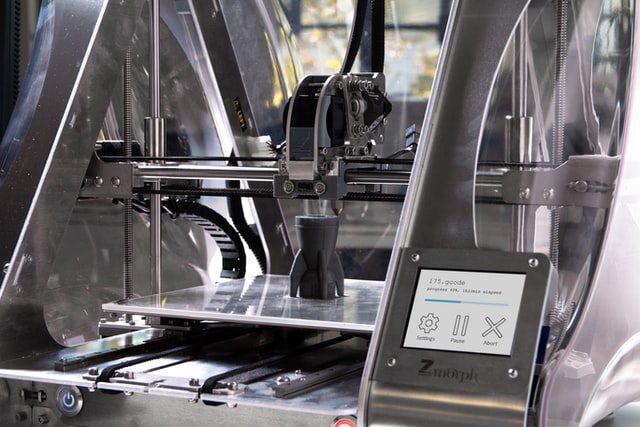
Industry 4.0 has brought several innovations to manufacturing processes. In this scenario, a technology that stands out is 3D printing.
In addition to enabling the reduction of various costs and time spent on production, it is also possible to minimize countless failures with this resource, making it an essential tool in the context of constant transformation that we are experiencing.
Want to know more about 3D printing, its advantages, and the role of technology in industrial processes? Continue reading this article.
What is 3D Printing?
3D printing seems like a very current solution, but in reality, the first equipment capable of printing objects from a digital design was created in 1984 by engineer Chuck Hull.
Known as stereolithography (SLA), the first version of the three-dimensional printing technology worked by overlaying thin layers of liquid resin, which solidify after reacting with ultraviolet lights.
Two years later, another technology began using a powder material to create the layers, called selective laser sintering (SLS). Meanwhile, the model most used today, Fused Deposition Modeling (FDM), was created in 1989.
The FDM model works by fusing a solid filament, which is usually a thermoplastic material. Thus, it produces objects layer by layer from a design.
Also called additive manufacturing, 3D printing spent a considerable amount of time with its use heavily restricted due to patented technology, with large companies and research centers being the ones that most used this printing model.
Open source and new models
Following the expiration of the FDM patent in 2009, an opening occurred that enabled the creation of a kit with all the necessary parts to build a more economical 3D printer, called Cupcake.
This open-source movement also enabled greater collaboration among researchers and users, who together began to further improve the technology.
Today, 3D printing already has an established market with a financial movement expectation of 32.78 billion dollars by 2023.
Industry is the main user of this innovative technology, as the 3D printing technique presents several benefits for the industrial manufacturing and maintenance process.

What is the impact of 3D printing technology on the production process?
3D printing is being applied in various sectors because it is a highly adaptable technology. In the production process, it has facilitated work in factories, especially in production lines with lean manufacturing.
Overall, the production chain generates an accumulation of waste and involves a series of costs, which can be minimized with the use of the three-dimensional printing technique.
This makes everything smarter, customized, and meets the needs of both industry and consumers.
Countless companies have adopted 3D printing for product prototyping, which has caused significant impacts on the global supply chain, being one of the trends for the future of industrial production.
Develops, produces, and delivers with greater agility
With 3D printing, it is possible to ensure much more agility, quality, and scalability to processes, providing companies with industrial equipment and customized solutions according to changes in customer demands.
This technology, besides bringing more connectivity and intelligence to business, has contributed to improving the ability to develop and deliver solutions with much less time and resources.
Competitive prices
The advancement of 3D printing technology has also brought more flexibility to meet the personalization process, reinventing the relationship between cost and profit margin.
This smart manufacturing is capable of providing real-time data that optimizes factories and inventory control, creating new levels of productivity and competitive market prices.
Customized production
Another point is that customized productions allow the construction of prototypes that significantly reduce production deadlines.
In addition, they assist in advancing the production line and manufacturing spare parts, which guarantee more support to customers according to their demands for discontinued products.
Design optimization
3D printing has also brought greater ease in optimizing part design, which can be customized according to customer expectations, reducing costs, materials, and accelerating post-production processes.
Significant waste reduction
Finally, there is a considerable reduction in waste within factories, capable of making a company more sustainable and competitive through differentials in waste management and industrial recycling processes.
What advantages does 3D printing bring to industries?
Of course, just from these items we can already see countless advantages of applying 3D printing in industries, but the benefits do not stop there.
One of the main advantages lies in maintenance, which is a very important area in industry regarding corrections, prevention, and predictive analysis.
Deliveries, therefore, become of higher quality, speed, and assertiveness, optimizing the entire production chain up to the final consumer, avoiding delays and various other impacts of production planning without technology.
In this sense, responses to daily challenges become faster and safer, adding more value directly and indirectly, especially since additive manufacturing delivers highly resistant and precise parts.
In addition, the printing of highly resistant metals, composites, and polymers brings more precision and geometric freedom to the additive manufacturing method, facilitating plug-and-play equipment in a much more connected way.
In other words, with 3D printing, it is possible to deliver customized parts at any time, without limiting production to a physical or third-party inventory, bringing much more operational efficiency.
Now you know what 3D printing is and how it streamlines the manufacturing process. To learn more about how to optimize factory operational efficiency, read our article.

