
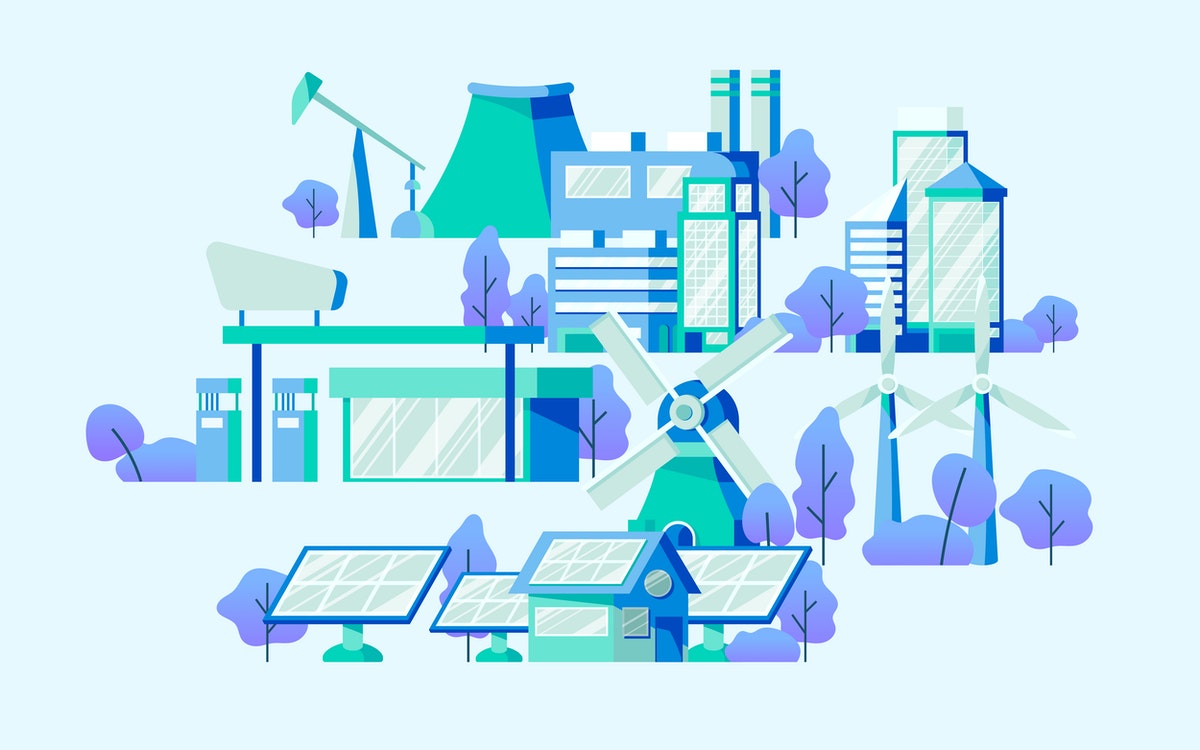
To keep the business competitive in the face of digital transformation, there are some aspects to be understood in the production scenario, and one of them is certainly the term sustainable industry.
This is because competitiveness and sustainability are factors that go hand in hand. After all, the lack of available natural resources can generate increased expenses and directly affect companies.
Furthermore, it is not only corporate behavior that has changed regarding the environment, but also consumer behavior, who are currently more concerned about the environmental and social impacts caused by organizations.
Therefore, the sustainable industry has been an important issue for businesses, leading to the adoption of principles that combine productive efficiency and social responsibility.
Want to know more about what a sustainable industry is and what the scenario looks like in Brazil and around the world? Continue reading this article.
What is a sustainable industry?
A sustainable industry is one that considers environmental preservation in its processes, continuously seeking to adapt its production with a view to protecting nature.
However, it should not be seen as a mere theoretical concept, but rather as an efficient production strategy, focused on both quality and sustainability.
In the business field, being sustainable is an urgent necessity, whether to meet consumer expectations or to project an image of trust and growth in the market.
In this scenario, it is possible to align practices that improve strategies while avoiding negative impacts on the environment, such as the use of so-called “green products”, industrial waste recycling, less polluting means of transport, and the hiring of sustainable partners and suppliers.

Sustainable industry in Brazil and the World
The first point to consider when it comes to sustainable industry is that gas and waste emissions must be kept within limits established by the federal government. Companies that meet this demand receive the environmental management certificate regulated by ISO 14001.
A success story nationwide occurred in 2018 when the cosmetics manufacturer was considered the 14th most sustainable company in the world, according to the Global 100 ranking prepared by the Canadian media and research company Corporate Knights.
The study took into consideration financial statements and reports regarding energy consumption, carbon emissions, waste production, innovation investments, and supplier partnerships.
Biomimetic
In this same context, examples of sustainable industry initiatives include the creation of the Biomimicry Institute, which brings together areas such as design, architecture, engineering, and science with the goal of creating industrial processes based on nature’s functions and forms.
The initiative founded by Janine Benyus already has a history. Velcro, a material created in 1941 by engineer George de Mestral, was based on the prickly shape of burdock seeds.
After examining the material through a microscope, the researcher noticed that the strong adhesion of burrs to fabrics came from several intertwined filaments ending in small hooks.
For a few years, the Biomimicry Institute has fostered an online and collaborative community for exchanging information among researchers in the field, aiming to create solutions such as wind turbines based on the functioning of whale fins.
Fields of action of the sustainable industry
The sustainable industry encompasses various fields of action to ensure the efficiency of its results. Some examples, described by the National Confederation of Industry (CNI), involve:
- Bioeconomy: efficient and sustainable use of nature’s resources and utilization of the country’s biodiversity;
- Circular Economy: utilization of natural resources aimed at increasing competitiveness;
- Renewable Energy: participation in the global energy matrix through renewable energy sources;
- Forests: Brazilian prominence in the international market and sustainability agenda regarding the forestry sector;
- Environmental Licensing: transparent and clear rules in the environmental licensing process;
- Climate Change: linked to economic competitiveness and the climate change agenda beyond the environmental sphere;
- Water Security: development of safer industrial solutions to guarantee water security;
- Solid Waste: alternatives for the scenario of natural resource scarcity and approaches that recognize the value of waste.
How to become a sustainable industry
To become a sustainable industry amidst this entire scenario, it is necessary to encompass concepts such as innovation, technology, strategic analysis, and planning that integrate sustainability into the core business functions, while also thinking long-term.
A very practical example to achieve this goal is to rethink energy consumption, reducing waste from inefficient machinery, modernizing equipment, and adopting clean and renewable energy sources.
Additionally, the 5 R’s policy is a great start to improving environmental practices, focusing on actions such as: rethink, refuse, reduce, reuse, and recycle. These can be applied in the following ways:
- Rethink: reflecting on processes aimed at sustainability; rethinking environmental responsibility regarding raw material choices, partner conduct, and waste disposal.
- Refuse: stopping partnerships that negatively impact the environment; forming alliances with organizations holding environmental certifications.
- Reduce: decreasing excesses in waste production, preventing waste, and substituting raw materials with reusable, biodegradable, or recyclable materials.
- Reuse: optimizing costs by reusing inputs, such as implementing water and packaging reuse systems;
- Recycle: recycling liquid and solid waste without generating environmental liabilities, repurposing paper, plastic, and even organic waste.
Did you like the content? Keep following our blog and receive more interesting content about industry!

