
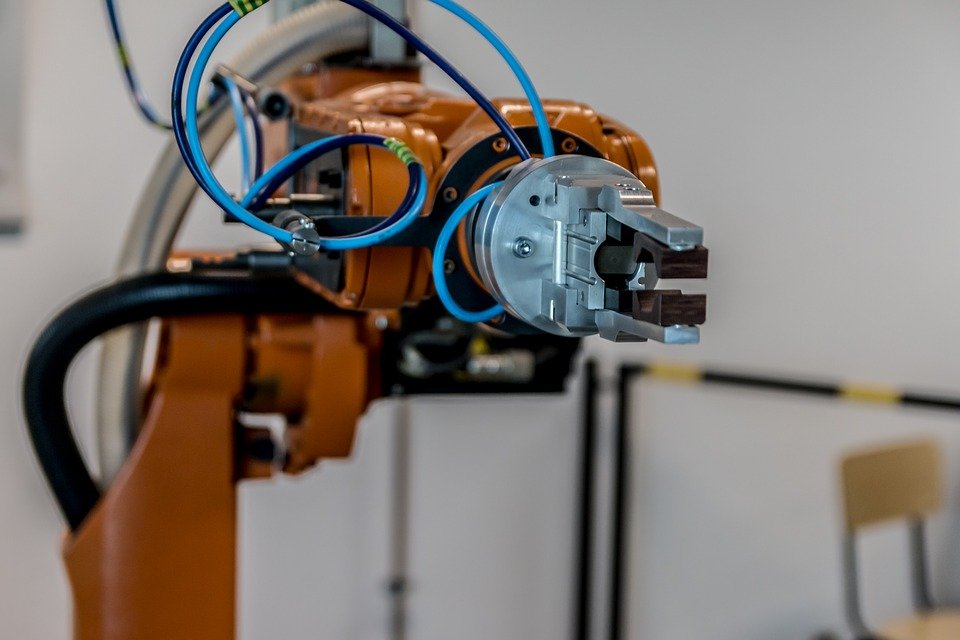
Industrial automation is producing structural transformations in the industry. Automated systems are part of a series of changes brought by the advancement of Industry 4.0, a new industrial era that aims to modify production processes through the use of technologies and automation.
Facing the high competitiveness of the sector, industrial automation has the potential to optimize productive activities in a factory. Thus, automated systems are making the industry even more productive, modern, and effective.
Is your business prepared to keep up with the transformations that industrial automation is bringing to the market? Find out in this text.
What is industrial automation?
Industrial automation consists of the use of technologies for the integration of physical and digital processes in a factory. Thus, systems are capable of automatically controlling the industry’s production processes.
This system uses technological elements to perform activities in order to increase productivity, reduce time, and optimize production processes.
Thus, operations are designed to occur without significant human intervention.
The main technologies that make up automated systems are:
- Artificial Intelligence (AI): a tool that enables autonomous operation and software learning.
- Internet of Things (IoT): a resource that enables the connection between machines via the internet for the activation of coordinated actions.
- Cyber-Physical Systems (CPS): reproduction of a factory’s physical processes in the digital medium.
Why is industrial automation important today?
The industry is experiencing an important period where a series of technologies are transforming production methods in factories. This era, known as Industry 4.0, is introducing innovations in industrial automation to the market through technologies.
Popularized since the first decade of the 21st century, the term Industry 4.0 continues a series of changes in economic activities marked by technological innovations. These structural changes in production methods mark the phases of the Industrial Revolution.
The 4th Industrial Revolution is characterized by the integration and decentralization of production processes. Therefore, automated systems allow connectivity between different operations and indicate information-based decision-making.
These innovations have allowed increased productivity, cost reduction, and process acceleration without compromising quality.
Pillars of industrial automation
To understand the importance of implementing industrial automation in a factory, it is necessary to understand the 5 pillars that sustain this system:
Modularity
One of the characteristics of automated systems is modularity. That is, the ability to adapt a production process on a factory floor. Industrial automation allows production systems to be more flexible, making it possible to change modules whenever necessary.
Decentralization
Fault notification devices and data analysis comprise an automated production system. These technologies help managers resolve bottlenecks when facing problems.
Since little human interference is required to monitor and analyze indicators, these resources decentralize decision-making.
Virtualization
In industrial automation, physical and digital processes merge. With virtualization, it is possible to simulate and monitor physical processes remotely in an industry.
Interoperability
Information is a key piece for the operation of an industry. Automated processes allow more effective communication between machines, workers, and cyber-physical systems.
Thus, interoperability is the ability to exchange information between the elements of a production process.
Real-time data
With the automation of production processes, data collection on operations occurs automatically. In other words, data and information are generated in real time, as are the analyses.
To store this data, storage can occur via a cloud database accessible via the internet.
Types of industrial automation
Industrial automation can be categorized according to its production method, each having its own advantages and characteristics, and it is necessary to understand them to see which ones can be useful for your factory. We can segment them into:
1- Fixed automation
Generally used in automated assembly lines, this automation system responds to a fixed equipment configuration. Thus, there is no possibility of customizing operation controls. The advantage of fixed automation is large-scale production of a single product.
2- Programmable automation
This type of automation allows the reconfiguration of software programming. Therefore, it is possible to alternate the production of different products and reprogram operations on the same machine.
3- Flexible automation
In a flexible and agile way, this type of automation allows modifications to product design. Thus, it is possible to produce a variety of products in a short period.
4- Integrated automation
This is one of the most advanced automation solutions. This is because integrated automated systems enable all processes on a factory floor to be operated by robots, from design to dispatch.
How industrial automation can help your business
Before deciding to invest in industrial automation as a solution for the factory, it is necessary to understand the basic principles and see if they are compatible with the company’s expectations:
- Instruction program or machine programming: regardless of the production volume, all equipment and modules of the automated system have an instruction program, that is, programming that directs processes.
- Power source: additional energy is required for the automation of production processes.
- Control system: it is the element that executes the programmed instructions in an automated system.
The automation of industrial processes aims to modernize productive activities, making them efficient, safer, and optimized. To this end, human processes are minimized, and automated systems come into play. We can mention some of the advantages of industrial automation, such as:
- Productivity: without losing production quality, industrial automation allows the reproducibility of processes at a higher speed, thus generating an increase in productivity and efficiency.
- Monitoring: through remote monitoring technologies, it is possible to interact with and manage machines and productive activities on a factory floor from a control center, providing more controllable, safer, and faster operations.
- Cost reduction: industrial automation systems can be developed with the aim of saving energy. In addition, they allow better management of inputs and equipment, reducing losses.
- Quality: industrial automation has the capacity to produce precise and effective operations. In other words, automated machines eliminate the possibility of human error and enhance product quality, even when production is done on a large scale.
- Safety: because they are controlled by computers, automated systems reduce the chances of accidents and eliminate the possibility of errors.
- Competitiveness: the process optimization promoted by industrial automation in an industry will guarantee competitive advantages for your business, as investment in innovation is essential for increasing productivity and reducing costs.
Now that you understand the main characteristics of industrial automation, learn more about new industry trends. Follow our posts here.

