
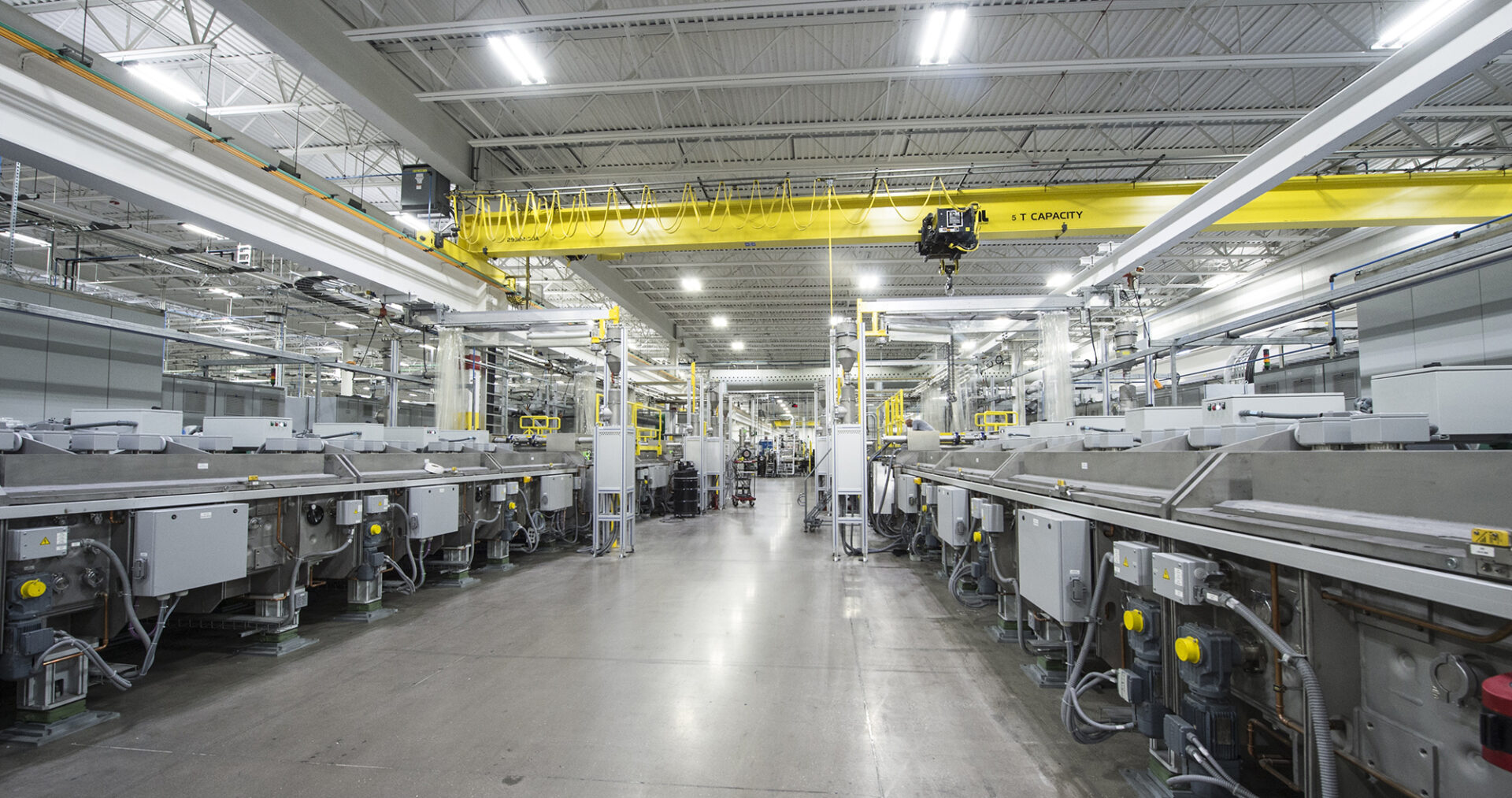
Have you ever wondered how your company’s operations area is organized? A well-planned industrial layout can positively affect productivity.
With market competitiveness and the use of technologies adopted by factories, organization needs to be considered as a relevant topic. Therefore, in this content you will learn:
- What is a manufacturing layout?
- What is the impact of the manufacturing layout on productivity?
- How to choose the industrial layout?
- How to use technology in the manufacturing layout
Make the most of each of these points and transform your factory in a planned and objective way. Enjoy your reading!
What is a manufacturing layout?
The industrial or manufacturing layout refers to the organization of the shop floor, taking into account the position of machines and workspaces.
Although planning the industrial layout is a task full of details and steps, the results can contribute to the growth and expansion of the company.
Therefore, anyone who thinks this activity is done merely by randomly distributing furniture or departments is mistaken.
It is necessary to ask some questions aiming at all processes, steps, and objectives involving the company, such as:
- What will be the method and space for supply?
- How will equipment maintenance be performed?
- Where will the inventory of raw materials and finished products be located?
- What is the daily production volume?
- What is the company’s growth expectation?
- How will the access locations to this equipment be?
In view of this, it is necessary to take into consideration all variables that may arise during the production process, aiming at higher productivity.
This is why it is so important to plan the industrial layout strategically, in order to achieve different benefits, both in terms of ergonomics and accessibility, as well as in saving time and space.
Thus, an organized company that thinks about its teams, suppliers, and customers has everything it takes to achieve market success. See below how a good industrial layout impacts your factory.
What is the impact of the manufacturing layout on productivity?
Time greatly impacts the production volume of factories, and a planned layout can be the key to success in achieving greater agility and productivity.
In this context, technology can be used as a partner for your industry’s growth. Learn more below about the benefits that the manufacturing layout aligned with technology can offer your work routine.
Savings and supplies
Through integrated systems, you can combine the factory’s industrial layout with product storage spaces, for example.
Thus, having inventory control in the palm of your hand and connected to the operations area will ensure greater productivity for your routine.
If you want to save time and ensure that no product is missing in the operations area, plan the industrial layout by integrating these areas.
With this, it becomes easier to contact suppliers, receive raw materials, and store products, generating savings in time and money.
Prevents accidents
Through objective and detailed planning of the industrial layout, it is possible to offer greater safety for your employees.
This is because workplace accidents are often caused by poor equipment arrangement or lack of maintenance.
Therefore, it is extremely important to think about the layout aiming at productivity and operational efficiency, without leaving safety aside.
With this, it will be possible to reduce accidents, value the workforce, and ensure that everything happens within the plan.
Better visualization of the production flow
The industrial layout must also be planned with the production flow in mind, not just to track processes, but to connect the stages.
In addition to facilitating the visualization of the production chain, the manufacturing layout that operates with continuity offers fewer errors, greater agility, and production continuity.
It is also worth highlighting the standardization of products and services, since they will be connected on the same production base.
In other words, if any problem occurs during the flow, it will be possible to correct errors more accurately and quickly, analyze productivity, and expand services.
Better customer service
Although the industrial layout offers greater internal agility and convenience for companies, it also directly impacts customer service.
This occurs through monitoring operation processes, since the factory will be able to offer what it actually has produced.
In addition, many customers seek to get to know industries before closing deals, meaning an organized space can help in this process.
This point is extremely important because you will be able to plan a place to meet with your customers, besides ensuring the best experience for the tour of your industry.

How to choose the manufacturing layout?
There are 4 types of industrial layout most used in factories, each with distinct objectives.
To make identification and your choice easier, see what they are:
- Product Layout: ideal for mass production of products, since machines are arranged side by side, with an automated and fixed process;
- Process Layout: machines are separated by departments, offering production of different products within the same company;
- Cellular Layout: operates with references from Product and Process layouts, as it offers both specific and sequential spaces;
- Fixed-Position Layout: perfect for large products, such as ships or aircraft, since the product remains stationary and employees move around it.
Given these four types of layout, it is necessary to find the one that best relates to your industry, taking into account:
- Time it takes for the product to be ready;
- Types of manufacturing processes;
- Tests to define the best layout.
With this, it will be easier to choose the industrial layout that best fits your goals, ensuring the best return.
Technology in the manufacturing layout
Technology is an important tool to improve processes, ensure innovation, and project paths for your business to continue growing.
Thus, using technology in the industrial layout can simulate how machinery will be arranged, besides ensuring a reduction in production time and risks to your employees.
All this in a more accurate way, facilitating the virtual analysis of the layout before it is put into practice, guaranteeing success.
In addition, it is possible to measure the best scenarios and results that can be achieved with the application of a planned industrial layout.
If you want to stay on top of what’s trending in the industrial sector, download the material right now: “Industry trends: how to stand out in the market?”
