
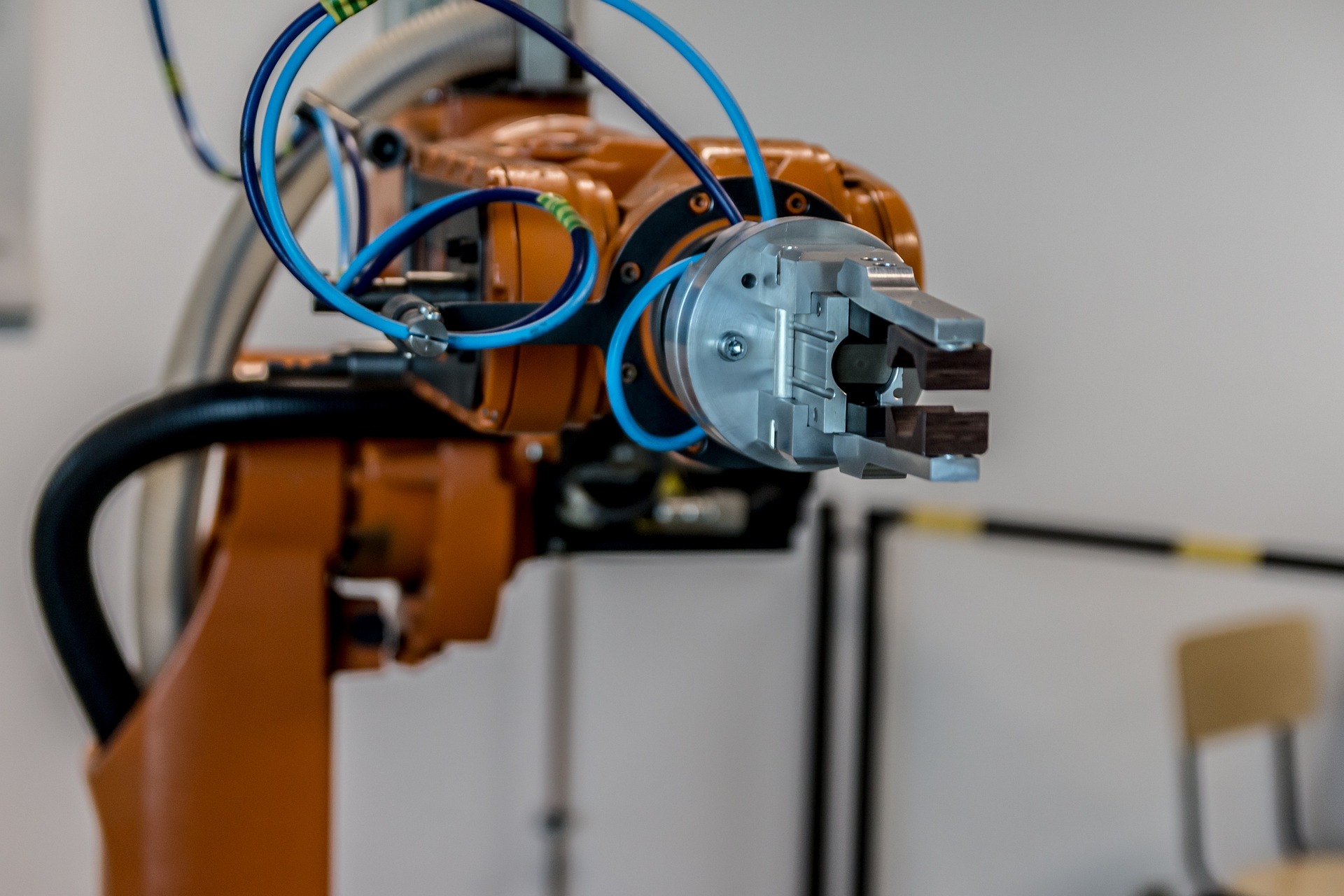
The technological revolution has continued to advance and, in the context of industry, one of the biggest milestones has been the integration of industrial robots into production lines. In fact, these robots, far from being a futuristic idea or exclusive to science fiction films, are an increasingly present reality in factories around the world. But after all, what exactly are industrial robots, how do they work and what is their role in the future of manufacturing? To answer these questions, we have prepared complete content for you to understand every detail.
What are industrial robots?
In general, industrial robots are programmable machines that perform a series of tasks automatically, without the need for constant human intervention. These machines have mechanical arms and articulated connections, which allow them to perform precise and varied movements.
In addition, robots can be designed to perform a wide range of activities, such as moving parts, welding, performing quality inspections and even painting or packaging products. As a result, these robots are critical to increasing productivity, safety and precision in factories. They help eliminate repetitive, dangerous tasks that require a lot of physical effort from workers, providing a safer and more efficient environment.
Advantages of using industrial robots
To better understand the impact of this technology, see below some of the main advantages of industrial robots:
- Safety and risk reduction: By replacing workers in potentially dangerous activities, such as handling toxic, hot or flammable substances, robots help reduce the risk of accidents in the workplace.
- Increased productivity: Unlike humans,robots do not get tired and, therefore, can operate continuously, 24 hours a day, without losing performance.
- Precision and consistency: They carry out tasks with great precision, ensuring the quality and standardization of products, which consequently reduces failures and waste.
- Improved ergonomics: By automating physically exhausting tasks, it reduces the chances of ergonomics-related injuries at work.
How did industrial robots evolve?
Industrial robots are not a recent invention. In fact, the first industrial robot was created in 1961 and used in the United States to handle heavy and hot parts in a factory. Since then, industrial robotics technology has evolved significantly, incorporating advances such as artificial intelligence, proximity sensors, machine learning and computer vision.
Currently, the use of industrial robots has grown exponentially. According to the International Federation of Robotics (IFR), the number of industrial robots in the world has doubled since 2015, reaching an average of 126 robots for every 10,000 employees in factories. This demonstrates how automation is becoming essential to modern industry.
Types of industrial robots
There are several types of industrial robots, each with specific characteristics and functionalities, designed to meet different production needs. Check out the main ones:
1. Cartesian Robots (or Gantry)
They have a rectangular structure and operate on three axes (X, Y, Z). They perform sliding, forward and backward movements, and are ideal for assemblies, 3D printing, handling sensitive materials and applications such as adhesives. Its main advantage is precision and the ability to carry out tasks on a large scale.
2. Articulated Robots
Inspired by the movement of the human arm, articulated robots have multiple rotating axes, allowing a wide range of movements. They are used in tasks that require flexibility, such as welding, cutting materials and packaging. The number of axes can vary from two to ten, depending on the complexity of the task.
3. SCARA Robots (Selective Compliance Assembly Robot Arm)
SCARA robots have an arm that moves mainly horizontally. Its main characteristic is the speed and ease of integration with other automated systems. They are often used for glue application, product inspection, palletizing and handling of semiconductorsemiconductor wafers.
4. Cylindrical Robots
With axes that operate in vertical or circular movements, cylindrical robots are generally used in simple tasks such as maintenance, material transport or casting. They don’t have the precision of other models, but they are ideal for working in tight spaces.
5. Polar Robots (or Spherical)
Polar robots have an articulated arm and a spherical base. Although not as popular today, they were used for tasks such as welding, stacking materials, and handling glass. Its main limitation is the need for more advanced control systems.
6. Delta Robots
Delta robots, also known as parallel robots, have three arms connected to a fixed base. Its great advantage is speed and precision. They are widely used in the food, pharmaceutical and electronics industries for transferring products, such as on packaging lines.
7. Collaborative Robots (Cobots)
Unlike traditional robots, which generally operate in isolated areas, collaborative robots, or cobots, are designed to work alongside humans on joint tasks. They are equipped with safety sensors to ensure they do not pose a risk to workers, and are used in activities such as inspection, machine maintenance and material supply. Its ability to safely interact with humans represents one of the greatest innovations in the field of industrial automation.
The impact of automation on industry
Without a doubt, industrial automation is not a trend of the future, but a present reality in many factories around the world. For this reason, the introduction of robots into production lines has a significant impact on company operations, as it improves efficiency and precision, as well as facilitating the integration of new processes and systems.
However, it is important to consider the challenges of this transformation. Although robots replace many repetitive and dangerous functions, it is important to highlight that they also create new job opportunities in areas such as robot maintenance, software development and management of automated systems.
Industrial robotics and the future of manufacturing
Given this scenario, it is clear that the future of manufacturing is intrinsically linked to robotics and intelligent automation. The adoption of technologies such asartificial intelligence, internet of things (IoT) and big data will enable industrial robots become even more autonomous and efficient. They will not only be able to perform complex tasks more quickly and accurately, but also learn and adapt to changes in production processes.
The transition to fully automated factories is not a distant reality, but an ongoing process. Companies that adopt these technologies have a significant competitive advantage, as they can produce faster, with less waste and with higher quality.
Industrial robots are transforming the manufacturing landscape, offering productivity, safety and precision at levels never seen before. With the advancement of technology, the tendency is for these robots to become increasingly sophisticated and capable of performing more complex tasks. The integration of these systems in factories represents not only an improvement in production, but also a change in the way companies operate and compete in the global market.
If you want to deepen your knowledge of industrial automation and robotics, check out articles and research from the International Federation of Robotics (IFR) and explore more about the latest technological innovations that are reshaping the industry industrial.
