
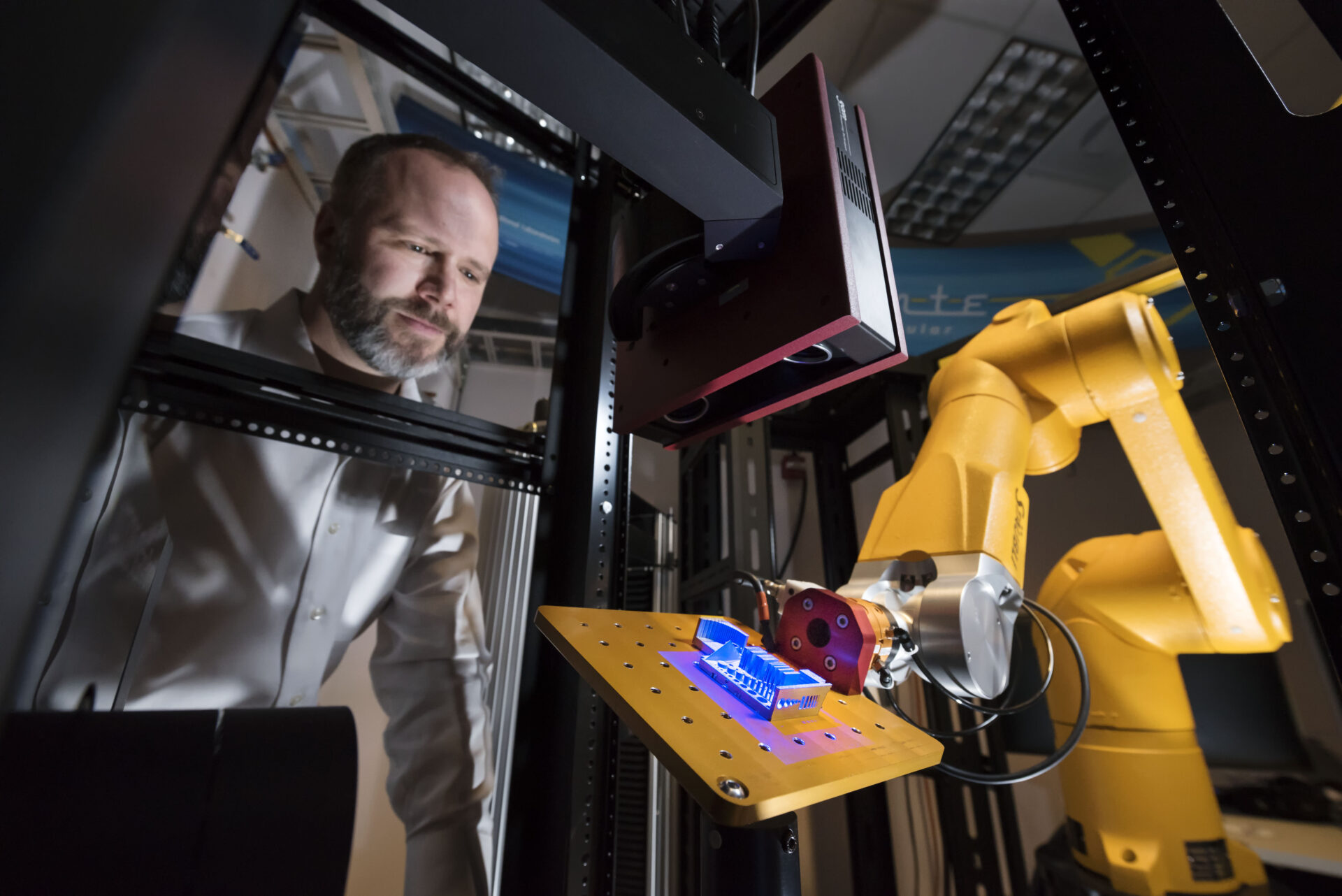
New technologies emerge every day, requiring people to adapt, and cobots are a prime example. They are part of industrial robotics and emerged to assist production processes and factory workers.
Read on to understand what they are and what their benefits are for the industry.
What are cobots?
Cobots are collaborative robots. They were developed with the goal of bringing more safety and working alongside people.
The expectation for the coming years is that their use will grow increasingly across all manufacturing segments. On assembly lines, the main applications are:
- Packaging processes;
- End-of-line;
- Palletizing;
- Machine tending, such as injection molding;
- Assembly processes;
- Quality inspection;
- CNC machine tending;
- Pick and place;
- Packing and palletizing;
- Injection part removal processes;
- Screwdriving processes;
- Production inspection;
- Polishing;
- Welding;
- Gluing.
Thus, they can be used in the production of machinery or raw materials for other sectors. As well as offering assistance for physically demanding tasks, providing force amplification, which helps to prevent strain injuries in workers.
What is the difference between collaborative and conventional robotics?
Collaborative robots work together with people, unlike conventional ones which must remain separated following specific rules to ensure everyone’s safety.
In collaborative robotics, the device features sensors so that if any contact occurs that poses a risk to human beings, it will automatically pause any process it is performing, preserving everyone’s safety.
Therefore, cobots were developed for industrial robotics to achieve integration between human and machine. Thus, there is the possibility for a human being to work in the same environment as robots.
Furthermore, the design of collaborative robots is made to minimize impact in case any contact occurs. Therefore, their arms are fully rounded.
In conventional robotics, which has been present in industry since the 1950s, conventional machines were designed to work in spaces that are totally isolated and enclosed with safety devices. This is done to detect the entry of people into the location and prevent accidents from occurring.
It may sound radical, but this measure must be taken because they operate at high execution speeds and with heavy loads, thus posing serious risks to the physical integrity of employees.
Do robots affect jobs?
Ever since robots began to be implemented in factories, there has been the stigma that people will lose their jobs. However, industries depend on manual labor to function.
According to research by the Boston Consulting Group, only 10% of tasks were performed by machines in 2015 across all manufacturing workshops.
This proves that industrial robotics has come to become a partner to workers, to perform work collaboratively and not to steal people’s jobs.
What types of collaborative robots exist?
In addition to the cobots mentioned up to this point in this content, there are other types of collaborative robots: AGVs and AMRs. Below, check out what their differences are:
AGV
An AGV is an Automated Guided Vehicle. Therefore, to move, robots of this type need guides, tracks, or magnetic tapes, meaning it is necessary to have a controlled environment.
These are increasingly being replaced by robots with more advanced technology, called AMRs.
AMR
AMRs are 100% autonomous mobile robots. They only need sensors and scanners to move. Unlike AGVs, a monitored space is not required because AMRs have built-in sensors and cameras.
Furthermore, they can even select the best route. They are smarter, easier to program, and offer greater flexibility. And they also have the function of collecting production data.
Pros and cons of cobots in industry
Conventional robots have a higher load capacity, whereas cobots require much less space in the factory layout. They are also easier to use. See the pros and cons of this type of collaborative robot:
Pros
- Collaborative and safe: as mentioned, human operators can be removed from dangerous jobs, as well as reducing repetitive functions that can lead to accidents. All this without losing the decision-making and discernment capacity of employees.
- More affordable than a conventional robot: cobots have a lower cost than conventional robots, enabling an increase in operating industrial robot inventories.
- Easy programming: even inexperienced operators can quickly configure and operate the robots thanks to advanced cobot technology.
- Flexible implementation: cobots take up little space and, being lightweight, are easy to deploy in different locations and for various applications. All without needing to change your production layout. Furthermore, migrating them to new processes is quick and easy.
Cons
Despite all the benefits mentioned above, cobots have a lower load capacity.
Because conventional robots are isolated, they have the capacity to move loads of up to a ton. On the other hand, cobots that work in the same environment with humans cannot move as much weight to prevent a potential collision with the team from causing harm.
Did you enjoy learning more about cobots and industrial robotics? Take the opportunity to check out our content “Are you prepared for the future of Manufacturing?”.
