
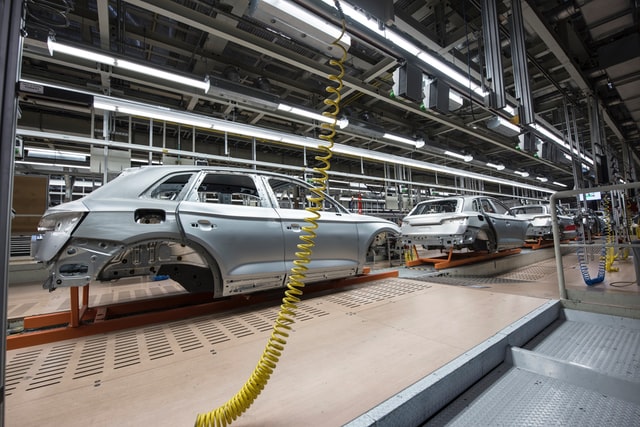
From the developments of post-World War II Japan’s reconstruction, it is still possible today to learn from the Toyota Production System (TPS).
If you want to know more about what it is, what the pillars and foundations of TPS are, and what the benefits of applying it on the shop floor are, keep reading this article.
What is the Toyota Production System?
After the spread of Fordism and American quality control methods, Japan began to improve production techniques until arriving at the Toyota Production System.
Within the context of the country’s reconstruction after World War II, TPS was developed by Toyota Motor Corporation, with notable contributions from chief of production Taiichi Ohno.
Driven by the need to bring more efficiency to production in the post-war period, the engineer used the concepts of jidoka and just in time, both created by Sakichi Toyoda and his son Kiichiro, respectively.
The result was the creation of the Toyota Production System, whose main objective is to unite the best quality with the lowest cost and optimized time, eliminating waste.
In light of this objective, TPS aims to maintain production flows in a simple and objective way, extinguishing redundant tasks and production bottlenecks.
The pillars of the Toyota Production System
The concepts that form the pillars of the Toyota Production System are the aforementioned jidoka and just in time.
The first concerns task automation with the help of machines, which took over operations previously performed by people, who in turn became responsible for monitoring.
More than just a concept, jidoka is characterized by industrial automations that keep production processes more efficient, while professionals ensure the operation of the production line and repairs.
Meanwhile, just in time refers to customized production, done only when necessary, at the right time, and with ideal resources.
In other words, it is characterized by prioritization, producing only when there is demand and avoiding excess inventory, which when stored and sitting idle loses market value and shelf life.
Furthermore, to avoid waste, resources are used in the exact quantity, avoiding leftovers and misuse, and leaving no room for errors when trying to speed up processes that require the correct amount of time.
The foundations of the Toyota Production System
In addition to the pillars that conceptually form the Toyota Production System, there are other foundations that support and ensure the smooth operation of production processes. Among them are:
Workforce rationalization
One way to level the work was to group workers into teams, each with its own leader, who coordinates the group and makes replacements in case of absences.
Thus, all effort is distributed, making work constant and avoiding idleness. Teams are responsible for general tasks and equipment maintenance, ensuring greater quality control.
Work standardization
To ensure correct operation, the Toyota Production System established standards for performing operations, ensuring that each collaborator knows their role, the time, and the resources necessary to carry out a given activity.
Flexible production
Moreover, to manufacture according to demand, production began to consider small batches, as opposed to Western models.
Thus, workers began to constantly change press molds, a process that was refined down to three minutes. Around the world, a whole day was required, which is why the process became known as flexible production.
Kaizen
Along with standardization, Kaizen is a technique of continuous improvement, which believes in maintaining a culture of change to improve production.
With this, it is possible to reduce expenses on dispensable actions and make room for innovation, with analysis and tracking models to identify problems.
Kanban
The Kanban emerged as a tool to improve workflow between stages, synchronizing production, ensuring fluidity in function performance, and reducing waiting time.
Poka-Yoke
This technique is characterized by ensuring error-proof and high-quality goods. In practice, it is a device that automates alerts when identifying errors, indicating corrections.
The 7 types of waste in TPS
Building on the main objective of minimizing waste to the utmost, the Toyota Production System defined a group of problems to be solved, the so-called 3Ms:
- Muri: related to excessive stress on a machine or operator;
- Mura: uneven distribution of work;
- Muda: waste of resources, workforce, and time.
From there, the third item, Muda, breaks down into the 7 types of waste highlighted by the Toyota Production System, which are:
1. Unnecessary processing
When producing something, many unnecessary activities and processes do not add value and must therefore be eliminated.
2. Overproduction
If the goal is to produce by demand, all surplus must cease to exist, ensuring only what is necessary at each stage.
3. Inventory
This is precisely where excess inventory comes in, limiting the budget and potentially causing product wear and tear.
4. Transportation
All logistics involves costs for moving materials, which is why transportation should be avoided or minimized as much as possible.
5. Motion
Just like materials, certain movements by employees are often unnecessary due to poor space distribution or workstations, for example.
6. Defects
To ensure the smooth operation of the business, it is necessary to produce it right the first time, avoiding rework.
7. Waiting time
Finally, idle time interrupts the ideal workflow and impacts industrial results.
What can we learn from this?
Given this complex scenario involving the Toyota Production System, we highlight some of the countless benefits to production processes. Among them are:
Employee engagement
By adopting a culture of waste elimination, the Toyota Production System helps the entire team understand activities, combining quality and process optimization.
With this, everyone works under the same perspective, aware of their role and available resources, in addition to having a broader analysis in problem-solving.
Improved communication
Furthermore, there is an improvement in end-to-end communication, because production becomes connected among all teams, alongside the stimulation of creativity.
Teams become more integrated and communication becomes more fluid as information clarity and objective task execution increase.
Waste reduction
Of course, the main objective of the Toyota Production System could not be left out, as these techniques aim to optimize resources, workforce, and time.
Every organization benefits from waste reduction, and with TPS it is possible to refine strategies in favor of reducing unnecessary issues.
Focus on continuous improvement
The Toyota Production System helps understand that everything can be improved, as long as there is attention and effort applied to the right measures and places.
Whether in reducing time or even identifying bottlenecks, it is possible to continuously improve processes and ensure a solid structure to face the challenges involving industrial processes.
Now you know what it is, what the foundations and pillars are, and how the Toyota Production System influences the shop floor. If you want access to more content about industry, follow our blog and stay up to date with the latest updates.

