
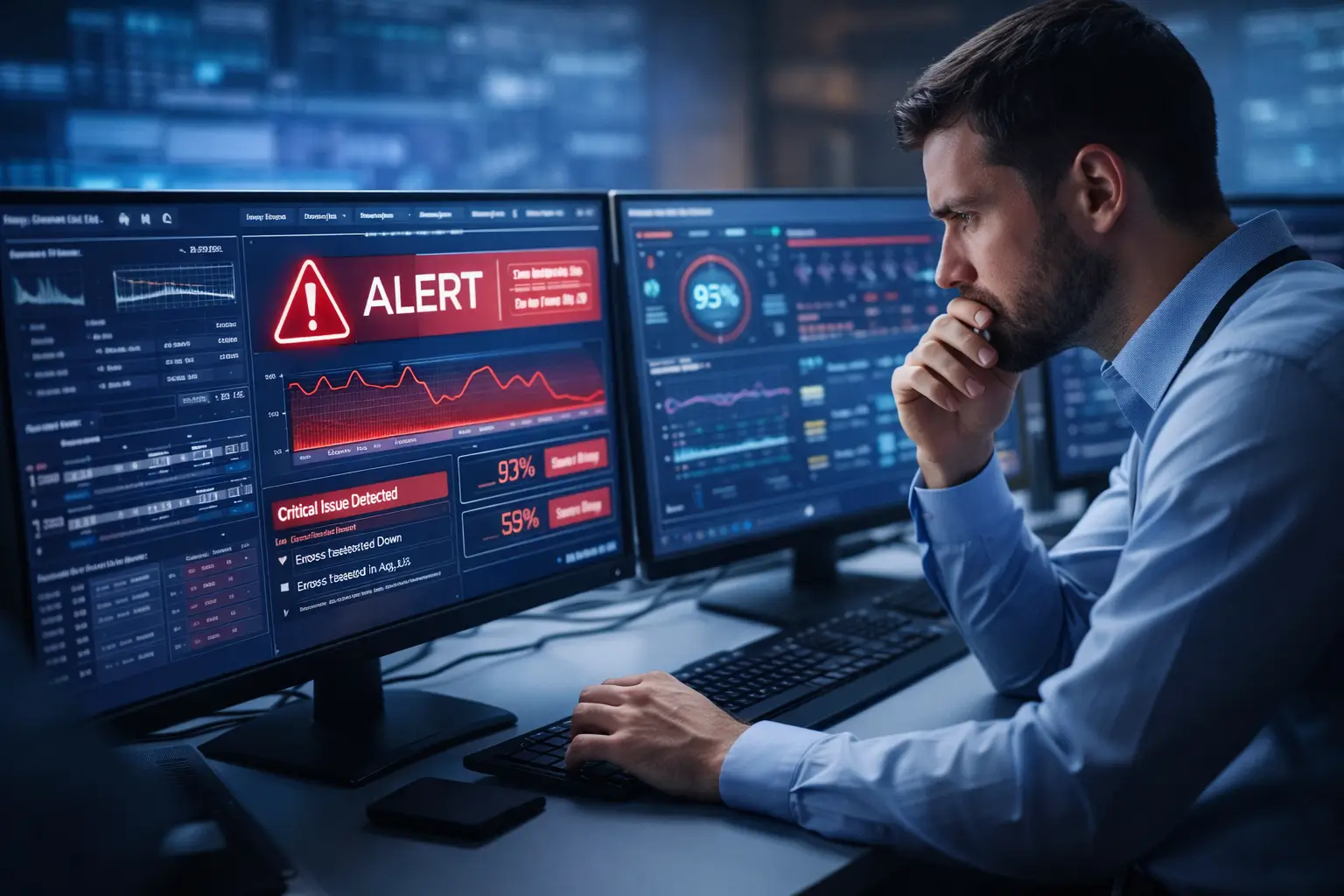
In any company that depends on critical systems, there is a truth that usually appears at the most inconvenient time possible: the business only realizes the value of technology when it stops working.
While everything is operating normally, ERP processing orders, MES collecting production data, integrations synchronizing information, portals serving customers and dashboards updating indicators in real time, technology seems invisible. It simply fulfills its role.
But it only takes a few seconds of slowness, a communication failure between systems or unexpected unavailability for this invisibility to disappear and the impact to become extremely concrete, because:
- A production line may stop.
- An order may no longer be invoiced.
- A customer can abandon a purchase.
- A manager can make decisions with incorrect data.
- An entire team can be mobilized in a hurry to find out what happened.
And, almost always, the same question arises: “How have we not seen this before?”
This is the function of modern application monitoring.
And when we discover problems too late?
In the digital and industrial market of 2026, technology response time has become directly proportional to the competitiveness of companies. This applies both to an industry that uses MES systems to coordinate its production and to a service company that depends on ERP, CRM, digital platforms and cloud integrations.
When a critical system degrades, the problem is rarely just technical. It turns into:
- Production delay;
- Loss of revenue;
- Operational rework;
- Wrong decisions based on incomplete data;
- Customer dissatisfaction;
- IT team burnout;
- Damage to the company’s reputation.
The most worrying aspect is that many organizations still only discover these problems when someone complains.
- The operator reports that data collection is slow;
- The customer reports that they were unable to complete a purchase;
- The financier notices that orders are no longer being processed;
- The board notes that indicators are inconsistent.
When this happens, the problem has already been ongoing for minutes, hours or even days. And, in the meantime, the business has already accumulated losses.
What is Application Monitoring (APM)?
APM is the acronym for Application Performance Monitoring or Application Performance Management.
In practice, it is a set of techniques, tools and processes that allow continuous monitoring of the behavior of critical applications.
The objective is not just to verify that the system is up and running. The real purpose is to answer questions like:
- Are users able to perform their activities normally?
- Are transactions being processed in the expected time?
- Is there any performance degradation?
- Are errors happening silently?
- Which component is causing slowdown?
- Is the impact already affecting business indicators?
In other words, APM transforms applications into observable environments, where each interaction can be measured, analyzed and correlated.
From traditional monitoring to observability
For many years, monitoring systems meant observing basic infrastructure indicators:
- CPU Usage;
- Memory consumption;
- Disk space;
- Service status;
- Server availability.
This data continues to be important. But alone, they only tell part of the story. Imagine that a server has a CPU at 25%, memory at normal levels and disk without any saturation. From the traditional view, everything seems healthy. However, users may be experiencing:
- Screens taking 15 seconds to load;
- Transactions crashing;
- Integrations failing;
- Data arriving late;
- Industrial processes running outside the ideal time.
In other words, the infrastructure seems perfect, but the user experience is compromised. It was precisely to resolve this gap that the concept of Observability emerged, which is the ability to understand the internal behavior of a system based on its external signals.
The three classic pillars are:
- Metrics – numerical indicators over time;
- Logs – detailed records of events and errors;
- Traces – tracing the full path of a transaction.
When these elements are correlated, the team is able to identify not only that there was a problem, but exactly:
- when it started;
- where it occurred;
- which component was affected;
- what was the probable cause;
- what is the impact on the business.
From reactive management to proactive management: why just “putting out fires” does not sustain the business
Many IT areas still operate in reactive mode. The cycle is usually always the same:
- A user notices a problem;
- A ticket is opened;
- The team begins the investigation;
- Information is collected manually;
- Hypotheses are tested;
- The incident is fixed;
- The business counts the impact.
This model consumes time, energy and resources. Furthermore, it always puts IT in a defensive position. Application monitoring completely changes this logic. Instead of waiting for the problem to be noticed externally, the environment starts to signal anomalies in real time. This allows preventive action. The team receives alerts when patterns emerge such as:
- gradual increase in response time;
- processing queue growth;
- repetitive integration failures;
- drop in transaction volume;
- abnormal resource consumption;
- unexpected changes in user behavior.
In practice, the problem is treated before it becomes unavailability.
A practical example in industry: monitoring MES before production stops
Consider an industry that uses an MES system to collect information directly from the factory floor. This system receives data from machines, sensors, PLCs and supervisory systems, consolidating information such as:
- real-time production;
- operational efficiency;
- stops;
- losses;
- quality;
- traceability.
Now imagine that the communication between the machines and the MES server starts to show increasing latency. At first, the impact seems small. The data takes a few additional seconds to arrive. Then the buffers start to accumulate. Then, information starts to arrive out of order. Dashboards no longer reflect the reality of the process. Operators make decisions based on outdated data.
If the situation continues to evolve, the line may be stopped to avoid inconsistencies or loss of traceability. Without advanced monitoring, the team will only notice the problem when the effects are already visible in production. With APM and observability, the scenario is different. The system identifies:
- increased communication time;
- volume growth in rows;
- intermittent connection errors;
- delay in updating indicators;
- reduction in processing rate.
Alerts are sent immediately. Experts investigate the cause, which may be related to the network, database, application configuration or infrastructure. The correction is performed while the operation is still running. The result is simple and extremely valuable:
Production continues, traceability is preserved and the business avoids unplanned downtime.
Monitor your business, not ‘technology’!
One of the most important advances in modern monitoring is the ability to monitor indicators directly related to the company’s results.
Because, at the end of the day, CPU and memory are means, not ends. What really matters is knowing whether the business is performing as expected.
In industrial environments
Some examples include:
- production orders processed per hour;
- average data collection time;
- MES availability;
- number of pending notes;
- synchronization rate with ERP.
In corporate environments
Can be monitored:
- orders billed per minute;
- invoices issued;
- transactions approved;
- average checkout time;
- integrations completed successfully.
On digital platforms
Indicators like:
- conversion rate;
- cart abandonment;
- API response time;
- end user experience.
When this data is integrated into technical monitoring, the company begins to see the direct relationship between systems behavior and operational performance. This completely changes the quality of decisions.
Security integrated with monitoring: How to do it?
In 2026, monitoring and cybersecurity go hand in hand. Many threats begin as small operational anomalies:
- unusual traffic spikes;
- non-standard accesses;
- sudden increase in errors;
- processes consuming excessive resources;
- atypical data movement.
In isolation, these signs may just seem like performance issues. When analyzed in the correct context, they can indicate:
- invasion attempts;
- denial of service attacks;
- early stage ransomware;
- data exfiltration;
- misuse of credentials.
For this reason, modern observability platforms also play an important role in the early detection of security incidents. The earlier an anomaly is identified, the smaller the impact surface.
Alerts don’t solve problems alone
Tools are essential, but not sufficient. A well-monitored environment can generate hundreds or thousands of events per day. The real challenge is in separating:
- relevant information noise;
- root causes symptoms;
- critical non-impact event alerts.
Without experience, the organization runs two equally dangerous risks. The first is to ignore important signs. The second is to react to everything, wasting time and focus. It is at this point that the human factor becomes decisive.
What is the role of specialized outsourcing?
When a company has a team specialized in support and monitoring, the data stops being just numbers on dashboards and starts to become concrete actions. These professionals:
- define relevant metrics;
- configure smart alerts;
- correlate events;
- identify trends;
- perform root cause analysis;
- recommend structural improvements;
- act preventively.
In practice, this means that the internal IT team does not need to dedicate continuous energy to operational surveillance. It can focus efforts on more strategic initiatives, such as:
- innovation;
- digital transformation;
- new projects;
- automation;
- process improvement.
Meanwhile, experts monitor the environment, ensuring stability and performance.
Efficiency in focus: what changes with proactive and robust monitoring?
When monitoring is treated as a strategy, its benefits appear in several dimensions.
Downtime reduction
Less interruptions and less downtime.
Faster resolution
Accurate diagnoses drastically reduce investigation time.
Better user experience
Operators, employees and customers interact with faster and more stable systems.
Increased productivity
Processes are no longer interrupted by recurring failures.
Greater predictability
Trends are identified before they become incidents.
Enhanced security
Anomalies are detected in their early stages.
Better use of the internal team
The team starts to work with a focus on growth and innovation.
Monitoring is an investment, not a cost!
There is an important change in mentality that more mature organizations have already understood.
Application monitoring is not an additional operational expense.
It’s an investment in:
- business continuity;
- operational reliability;
- productivity;
- security;
- capacity for innovation.
Companies that master observability are able to make decisions faster, reduce risks and sustain growth with greater security.
In a scenario where ERP, MES, integrations and digital platforms are the heart of operations, visibility is no longer a differentiator and has become a basic competitiveness requirement.
How does Teclógica support companies in managing and supporting applications?
Teclógica operates in the monitoring, support and specialized outsourcing of critical environments, helping companies transform their IT operations into a predictable, stable and results-oriented structure. Our approach combines:
- continuous monitoring of applications and infrastructure;
- observability with metrics, logs and traces;
- proactive performance analysis;
- expert support;
- incident and problem management;
- monitoring of business indicators;
- recommendations for continuous improvement.
With this, our customers reduce risks, increase the availability of their systems and free up their internal teams to focus on what really drives the business.
Don’t wait for the system to stop to act!
When a problem is noticed by the user, the impact has already started. The most important question is not whether your company will experience incidents. They are part of the reality of any technological environment. The real question is: will your organization have enough visibility to detect them before they affect operations?
Companies that invest in specialized monitoring and support achieve something extremely valuable: predictability. And predictability is what allows us to grow safely.
Talk to Teclógica
If your company depends on ERP, MES, integrations, corporate applications or digital platforms, don’t expect unavailability to compromise your production, your revenue or your customers’ experience.
Teclógica offers application monitoring, observability and specialized outsourcing solutions to ensure maximum performance of your operation.
Speak to an expert and discover how to transform monitoring into a competitive advantage.
