
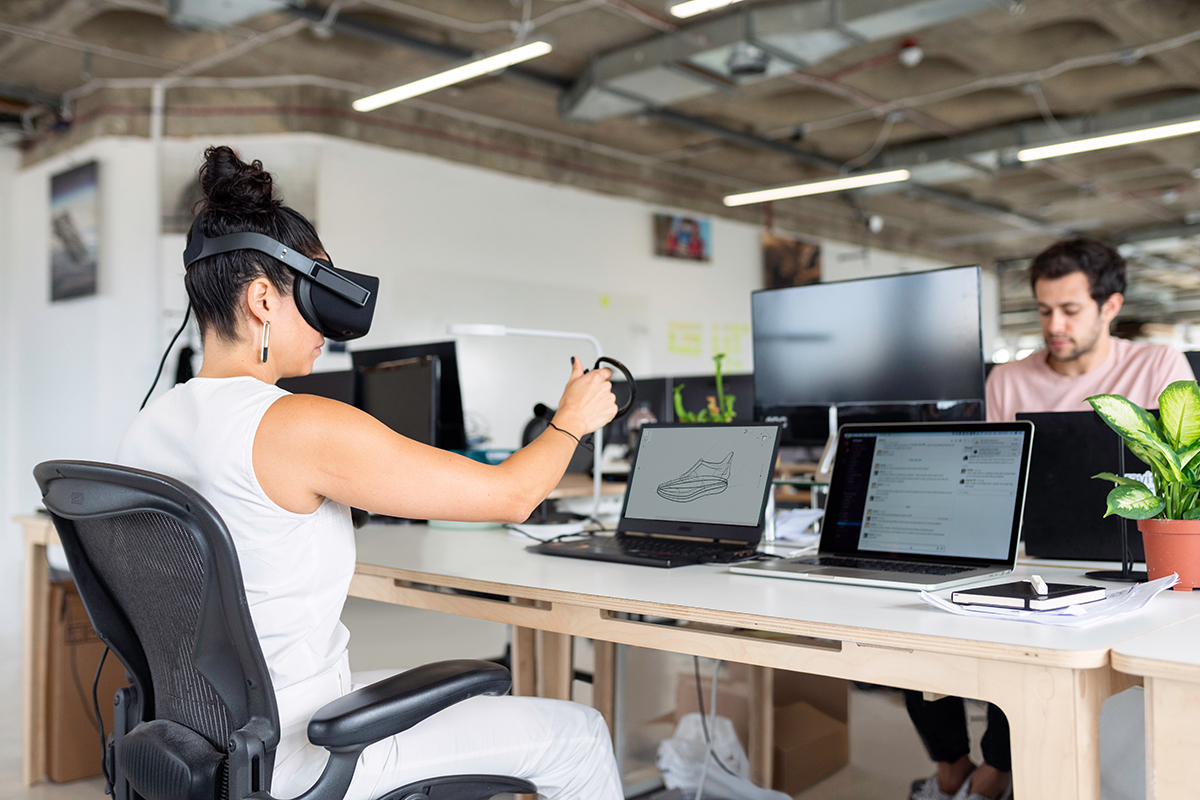
It has been some time since our relationship with certain technologies ceased to be restricted to one-off events. What was once exclusive to movie screens is now gaining ground in everyday applications. One example of these technologies is mixed reality.
With this in mind, throughout this article we will learn more about its concept, as well as its applications and effective impacts on industry to keep you updated on the subject.
What is mixed reality?
In short, it is a combination of the real and virtual worlds. Mixed reality glasses, for example, are equipped with sensors that see everything in a physical space.
However, instead of invading this environment, this type of technology integrates with physical objects by projecting virtual elements as holograms.
In the industrial scenario, digital elements can become a sort of guide for various functions. This is because, with this technology, a production manager can assist another professional with an industrial breakdown hundreds or thousands of miles away, for example.
Or even allow a manager to help with a serious incident on a factory floor with an on-site team. How? Exchanging information and data in real time.
Therefore, mixed reality is a resource that brings people closer, allowing everyone involved, whether present or not, to view the same elements of a space.
What is the difference between the types of reality?
There are still doubts about the differences between mixed, augmented, and virtual reality. To help you distinguish these terms, check out the characteristics of each below:
Virtual reality
Virtual reality creates a scenario where the user is placed inside a simulated and immersive experience.
Thus, objects and scenes look real. Examples include rollercoaster simulators, games, and immersions with virtual headsets.
All of this is created through graphic resources, 360º images, and other resources that provide a sense of presence.
Augmented reality
In augmented reality, on the other hand, the user can use a real-life scenario to interact with digital elements. Therefore, it is like a “mix” between what is real and what is not.
In industry, augmented reality allows testing prior to the implementation of a new process, for example. This makes it possible to simulate its degree of difficulty, as well as potential risks and failures even before putting it into practice.
Impacts of mixed reality in industry
There is a vast universe of applications for mixed reality in industry. Today, just to give you an idea, it drives advancements in energy, medicine, engineering, gaming, design, construction, maintenance, and much more.
In the automotive industry, this process is already being used by factory engineers. Basically, professionals drive and evaluate vehicle launches or new features even before they physically exist.
The action aims, above all, to eliminate bottlenecks in stages prior to car development. In general industries, this innovation also reduces communication failures.
And it doesn’t stop there, as it can also relocate workers from hazardous areas without losing process efficiency.
Imagine controlling the productivity of a mine via computer? Or viewing fuel flow remotely in a refinery? These and other technologies, such as cobots, are already a reality in the industrial market.
Benefits of mixed reality in industry
Continuous improvement
Mixed reality enables more complex studies and diagnoses to be performed. Examples include the creation of prototypes or digital twins. Consequently, costs and operation time are reduced. Furthermore, working conditions for the teams involved also improve.
Finally, continuous improvement can also be seen in training, as sessions become much more interactive when gamification is introduced. Learning becomes much more efficient, and employees acquire knowledge in a lighter, more interactive way.
Real-time integration
Integration and mixed reality are closely related. This is because the technology allows for immersive, real-time interaction, even from a distance. With it, an employee can view all essential virtual elements on a dashboard to complete a task, such as evaluating chart data, for example.
Safety
Another benefit of mixed reality is increased worker safety. By predicting when an environment or asset becomes hazardous, physical contact for the employee can be reduced. Additionally, it is also a way to allow them to adequately prepare to perform a repair or maintenance task.
Productivity
Using this innovation also boosts productivity. For instance, a control center worker can use digital twins to inspect distant electrical panels. First, they access motor information, understand the issue, and finally, make a diagnosis remotely.
With precise information, they can contact the technical team. Afterwards, the team can be dispatched already knowing how to solve the problem. The result is saved time and increased productivity.
Collaboration
Finally, mixed reality also encourages collaboration between cross-functional and global teams. After all, who wouldn’t feel more motivated in an environment full of rich, up-to-date information?
Thus, the team also gains motivation to explore their true potential. All within a scenario where they can test products and create solutions for the most diverse incidents.
Throughout this article, we have seen how new technologies are increasingly present in industry. Therefore, for the segment to remain competitive in the future, it is essential to stay on top of these and other incoming innovative tools.
Download our free e-book on cloud systems and discover this trend!

