
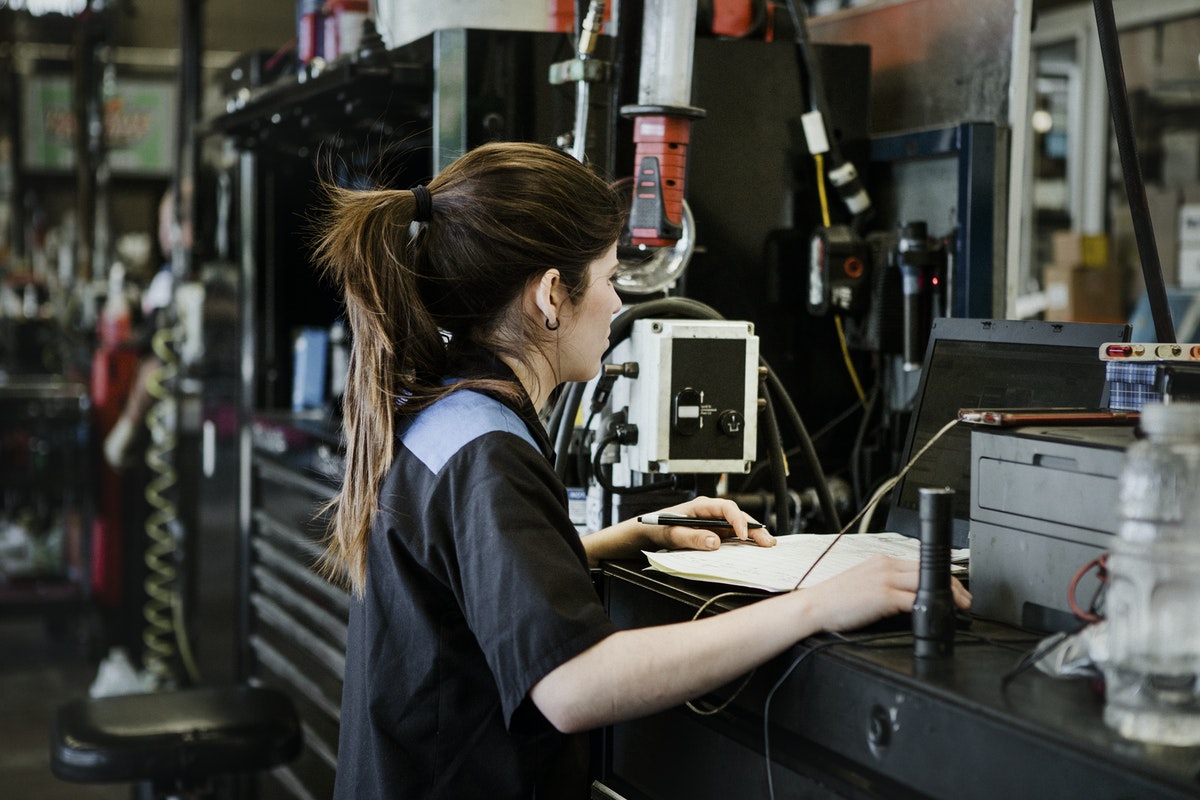
Today, May 25th, is an extremely important date as tributes are paid to one of the most representative production spaces for the national economy: industries.
This sector can cover the most varied types of markets, ranging from food products to apparel. And the concept of Industry 4.0, is gaining more and more ground in pursuit of industrial efficiency. In the Industry Day interview with CBN, we will discuss technological solutions for the industry in the post-crisis era with Aloisio Arbegaus, Commercial and Marketing Director at Teclógica.
You can follow the interview where we talk about industrial efficiency in industrial recovery via audio or through the text below.
Listen to “[Teclogica] Radio CBN – Industria 4.0” on Spreaker.
What is the difference between traditional industry and so-called Industry 4.0?
We can look at this from two points of view. The first point of view, that of the physical factory, is undoubtedly the technology used in Industry 4.0. The level of automation, the manufacturing systems that collect process data and information for increasingly precise and assertive deliveries, enabling decision-makers to achieve a higher level of assertiveness in the decisions they make.
In the second point of view, that of strategy, the difference lies in knowledge.
Many company decision-makers require a very high investment to become more efficient, and therefore they do not initiate a digitalization project. However, it is possible to map out a project to be implemented in phases, so that factories become increasingly efficient and consequently increasingly competitive.
In a crisis, companies that fit into Industry 4.0 adapt and reduce losses faster
Today, amid the crisis we are experiencing with the coronavirus and the global reality, are those operating within the Industry 4.0 concept managing to adapt and reduce costs and losses more quickly?
Yes, we can say that these companies are better prepared for market adversities, such as the current situation. They possess more accurate information from their factories, which allows them to make decisions and adjustments much faster.
We followed two industries here in the region, a chemical company and an equipment manufacturer, which quickly adapted. The chemical industry discovered it could produce hand sanitizer, and the equipment industry discovered it could produce ventilators. These industries obviously made certain decisions, looked at their plants, and realized that these adaptations were possible.
These industries are at a slightly more advanced level of automation, but with technology, this type of decision can also be made by other industries. Reducing present or future costs and losses, especially when the Return on Investment (ROI) is better—which is the goal of every business owner—is what companies seek when they adapt, partially or totally, to embrace the Industry 4.0 concept.
What should industries take into consideration when investing in technology for industrial efficiency?
When investing in technology, you first need to understand what the weaknesses are, or what the main pain points are that each industry or shop floor faces. We have some industries with multiple plants, multiple factories—some more automated, others still legacy. Therefore, it is necessary to understand what these industries’ main pain points are from an efficiency standpoint. This is done through mapping. From there, a project is assembled to gradually reach Industry 4.0 concepts and become more efficient.
How do you evaluate this reality of pursuing innovation and the industry concept in manufacturing plants here in the Itajaí Valley region?
It is still a challenge for Brazilian industry as a whole, as well as in our region. We have centuries-old industries, and in this sense, we need to make adaptations and seek knowledge. Industry 4.0 concepts can cause apprehension because they involve English acronyms and challenges that need to be overcome, but this can be done gradually.
We often talk about the Internet of Things (IoT), cloud computing, machine learning, and artificial intelligence. For those outside the technology field—which is the case for many industries—these topics sound frightening. But gradually—as I mentioned, having visited several industries in the region and many others across Brazil—they can map and identify points where they can be more efficient, generate added value, reduce losses, and pursue a series of improvements.
How can the coronavirus accelerate technological transformation in companies and industries?
This is yet another challenge. Brazilian industry has already faced so many challenges throughout its history. Here in Brazil, it is an even greater challenge now because the drop in industry revenue was drastic, exceeding 90% in some segments, such as the automotive sector. Now, the solution is to understand how the market will behave and how consumers will return after social distancing.
Industries are already preparing, looking outward at the movement of countries emerging from lockdowns and isolation, observing how consumers behave, and from there making projections and seeking actual adaptations in their plants to make up for these losses. Because the loss itself has already happened. Now it’s about seeking the help of technology and consultancies to carry out projects and try to achieve reductions and gains to minimize the losses that have already occurred.
Can technologies provide an opportunity for industries to return to their previous competitive pace?
Of course, it won’t be like before, but we must try to remember or think a little about the pre-coronavirus scenario and then resume part of that growth, based on everything we have been following. With new rules, new concepts, and even a new way of dealing with one another?
Precisely, technology—when properly deployed, and this is part of consulting processes—delivers greater efficiency, which is the target word. In the coronavirus scenario, every industry and business segment must evaluate to what extent it suffered losses, and which losses could have been minimized if technology had already been employed or if decision-making points could have occurred faster. So we always say that technology, by collecting information, compiles it and delivers more assertive data to decision-makers.
With this, decisions become faster, and crisis scenarios—or scenarios where things can go wrong—are mapped out in advance, leading to a point where you lose less money.
Obviously, the coronavirus is unprecedented; in particular, the last major pandemic, the Spanish flu, was in 1914, so of course many industries in the region or in Brazil were born after that. But through the use of technology, if properly employed, they can guard against future adversities.
How does Teclógica deliver solutions for the industry in a post-crisis moment?
Teclógica is a company turning 26 next month. As a service and product company, in the industrial sector we are partners with the French company Dassault Systèmes, which provides shop floor software such as the famous MES (Manufacturing Execution System), whose goal is to collect data and assist with operations, as well as a production planning software (APS) whose simulation allows companies to achieve the best efficiency for each line.
So, in terms of the industrial aspect, Teclógica is positioned this way. We provide consulting to understand which points can be improved in industries and determine which technologies are best suited for each reality—no two cases are identical, though similar cases may arise. A consulting process is necessary, and then a SWOT matrix (Strengths, Weaknesses, Opportunities, and Threats) is assembled, especially focusing on weaknesses, to position the company and source the technology and specialized labor needed to meet those demands, making the industries more competitive.
Did you like the text and want to know more about the solutions offered by Teclógica for the industry? Then click here and get in touch with our specialists.

